By adopting cutting-edge technology and providing data-driven, personalised care, QEI ophthalmologists are setting the standard for clinical excellence in Australia.
Latest laser technology
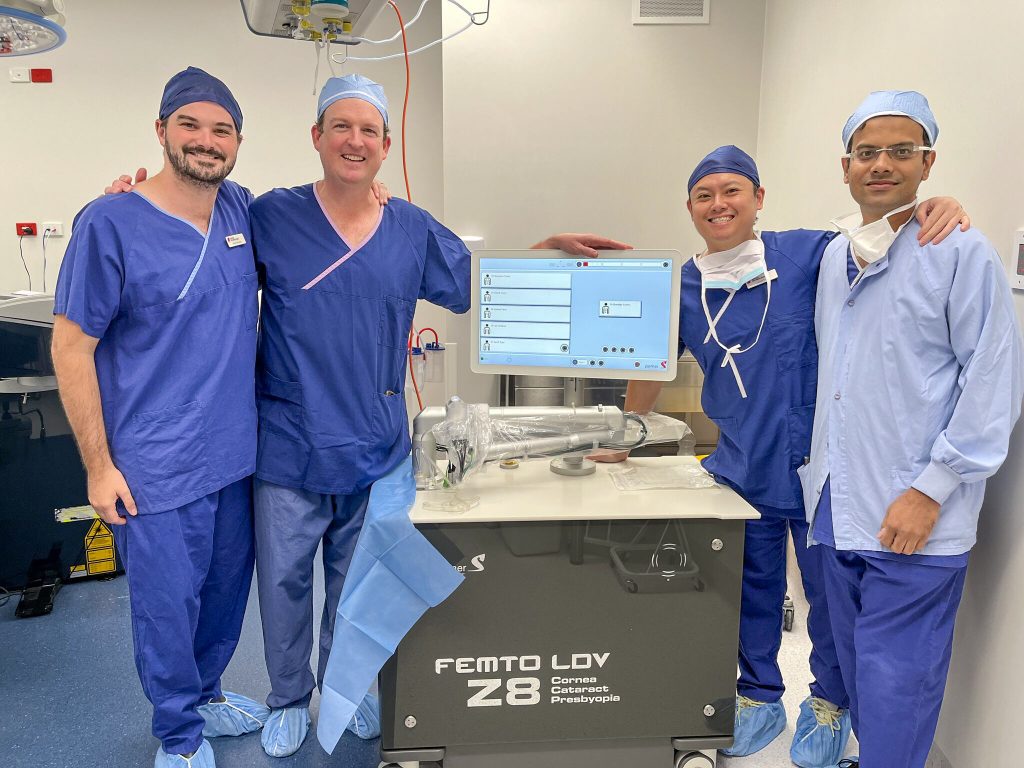
Drs Brendan Cronin, David Gunn and Lee Holland have invested in the latest laser technology to treat keratoconus and corneal disease at the South Brisbane Day Hospital. The QEI ophthalmologists are the first in Australia and only the second worldwide to adopt the new technology.
Dr Cronin and Dr Gunn worked closely with Swiss technology group Ziemer to refine laser surgery options for patients with corneal diseases. The resulting hardware and software upgrades to the Ziemer Z8 laser allow surgeons to customise donor tissue precisely for CAIRS Keratoplasty, a procedure where donor tissue is implanted into a patient’s cornea.
“The donor tissue that we now cut by laser can be customised to the individual,” Dr Cronin says. “So instead of being one standard piece that’s the same dimension the whole way around, we can customise it to account for parts of a patient’s cornea that are steeper or narrower.”
As the pioneers of CAIRS in Australia, Dr Brendan Cronin and Dr David Gunn are always working to improve visual outcomes for their patients. “This is what personalised medicine should be,” Dr Cronin says.
Authors of Brisbane Nomogram
At the same time, the duo has developed a nomogram providing more guidance for tissue placement by accounting for disease severity. A nomogram is a formula-based decision tool that converts clinical variables into a recommended treatment plan.
Corneal diseases and treatments involve variables such as corneal thickness, curvature, age, refractive error and healing response. Nomograms integrate these variables to guide individualised treatment settings, translating complex clinical relationships into practical, repeatable treatment adjustments.
Previously surgeons relied on more generalised approaches. “Until now, there has been no nomogram that accounts for different severity of disease in keratoconus,” Dr Cronin says. “Our nomogram lets surgeons look at mild, moderate, and severe disease. And that’s pretty exciting.”
The updated laser technology will allow the QEI surgeons to collect more data and further refine the Brisbane Nomogram for CAIRS “because, for the first time, we can record the exact volume of tissue implanted per patient”, Dr Cronin says.
The Brisbane Nomogram for CAIRS is published in Clinical and Experimental Ophthalmology. It can also be accessed via CAIRSPlan.com – a free surgical planning tool developed by Dr Cronin and Dr Gunn to support surgeons worldwide in mapping and executing the procedure for individual patients.
Learn more about CAIRS for treating keratoconus here.